 DePuff
Putting your face in ice water briefly narrows surface blood vessels, which may make puffiness look calmer, and triggers the dive reflex, which can slow your heart rate. Treat it as a temporary step: the evidence does not establish pore shrinkage or collagen building, and cooling does not resolve the underlying cause of puffiness. Cooling review, face-immersion study, Mayo Clinic.
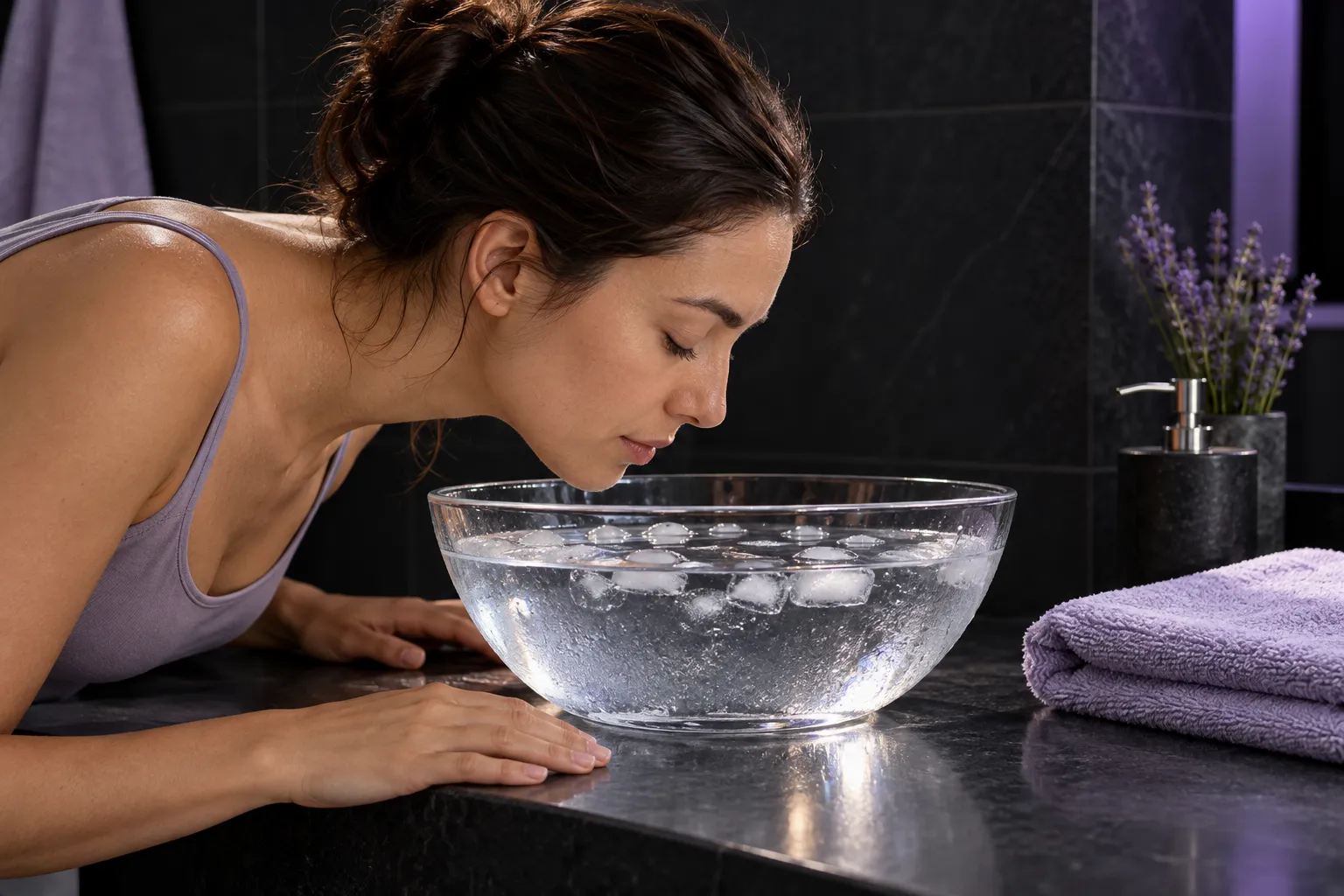
AI-generated illustration of a fictional adult.
You only need a clean bowl, water and a towel. The useful question is whether a short dip earns a place in your morning, so start small and judge comfort separately from appearance.
What does putting your face in ice water actually do?
The evidence is clearer for effects on heart rate and heart-rate variability than for a visible change in morning puffiness.
| Question | What the research actually studied | What that means for you |
|---|---|---|
| Can cooling reduce swelling? | In 50 rhinoplasty patients, one eye area received silicone gel packs and the other did not. The cooled side had less swelling and bruising over the first week. Kayiran, 2016 | Measured postoperative benefit; not a test of morning puffiness or a bowl of water. |
| Does cold on the face affect the heart? | Eight healthy volunteers tried face immersion with warm or cold water, with and without breath-holding. Cold increased a marker of vagal activity; the heart-rate slowing differed significantly from control only with cold plus breath-holding. Kinoshita, 2006 | A real physiological response, not a measurement of facial appearance or emotional calm. |
| Does a morning dunk visibly depuff a healthy face? | We found no controlled study measuring that outcome, or how long a visible effect lasts. | A plausible cosmetic benefit, without a proven size or duration. |
The 2025 cooling review discusses narrowing blood vessels around the eyes, but also introduces a device concept and calls for comparative research. It is not a clinical trial of that device or of DIY face dips.
None of these studies establishes acne treatment, fat loss or a lasting skin lift. Choose a dip for a brief cooling ritual, rather than expecting it to remodel your face.
Does ice water help a puffy face or puffy eyes?
If your main concern is under-eye puffiness, a washcloth is the easiest place to start. Mayo Clinic recommends a clean cloth dampened with cool water, held gently under and around the eyes for a few minutes while sitting upright. It does not require ice or submerging your nose and mouth.
Our puffy-eyes morning guide puts that step into an eye-focused routine. For broader cheek puffiness, you may prefer the all-over contact of a bowl, but the studies above give no reason to assume immersion beats a compress.
How long will it last? With duration unmeasured, check any difference again at the time you care about, such as before leaving home. Our guide to how long face debloating takes covers the wider timeline.
How do I dip my face in ice water, step by step?
Read the skip list below before trying this optional cosmetic routine. Allow a few minutes for setup, breathing breaks and cleanup; the time with your face in the water is much shorter.
- Set up a clean bowl. Choose one wide enough that your face will not press against the sides. Put it on a stable counter or table, leave space below the rim for displaced water, and set a clean towel nearby. Tie back long hair and remove makeup first.
- Start with cool tap water. If you want it colder, add a few cubes and stir. Check with your fingertips or hand before lowering your face. This checks comfort only; it does not rule out a cold-sensitive condition. Use the temperature guide below.
- Try one brief dip. Sit or stand securely, close your eyes, take an ordinary breath and lower your face into the water. Keep your mouth closed and lift out before you need to breathe. Start with about five seconds, or less if you want to come up sooner.
- Pause fully between dips. Breathe normally above the bowl until comfortable. If you want to repeat, choose one of the schedules below. Do not hyperventilate, force a breath-hold or treat the timer as a challenge.
- Pat dry and finish. Gently press the towel against your skin, then use your usual tolerated moisturizer. Empty and clean the bowl. There is no need to add another cold tool to finish the session.
How long should you put your face in ice water?
Pick one row, rather than working through them. These timings organize common short-dip habits; they are not proven safety thresholds or a prescription for results.
| Your plan | Seconds per dip | Rounds | Total time in water |
|---|---|---|---|
| First try | Up to 5 | 1 | Up to 5 seconds |
| Brief repeat session | 5 | 3 | 15 seconds |
| Another short option | 10 | 3–5 | 30–50 seconds |
| If 15 seconds already feels comfortable | 15 | 3–4 | 45–60 seconds |
Keep the total to about a minute or less, excluding breathing breaks. You do not need to reach the maximum, and a longer session has no demonstrated cosmetic advantage in the evidence reviewed here.

AI-generated illustration of a fictional adult patting dry.
How cold should the water be?
Use comfort to decide whether to proceed, not the number of ice cubes in a video. Without a thermometer, you cannot assign a precise temperature to your bowl.
- Cool tap water: a simple starting point. If this already feels unpleasant, choose the cloth option or leave cooling out.
- Water with a few cubes: stir, check, and dilute with more tap water if it feels sharply cold. A cube count is not a reliable temperature setting; bowl size and starting water temperature vary.
- Mostly ice or slush: skip this setup. Melting ice and water can approach freezing, and there is no established skin benefit from chasing that temperature.
Colder also changes more than sensation. In a study of 12 healthy adults, researchers applied water or ice-slurry packs to the forehead, eyes and cheeks for five minutes at each of six temperatures. Mean arterial pressure rose by about 13 mmHg at 7°C (45°F) and 25 mmHg at 0°C (32°F); vagal heart-rate-variability markers increased only at 0°C.
Those were packs, not immersion, and much longer exposures than the dips above. The findings do not establish an ideal bowl temperature or show that freezing water gives better skin results.
Why do people call it a nervous system reset?
The dive reflex gives the claim a physiological basis, but “reset” promises more than researchers measured. Vagal activity concerns the nerve signals that influence the heart; a change in heart-rate variability is not itself a report that someone feels less anxious.
A meta-analysis of 17 studies involving 311 people found an increase in RMSSD, a heart-rate-variability marker of cardiac vagal activity, during exposure, but no statistically significant increase afterward. It combined face immersion, face cooling, SCUBA diving and whole-body immersion. The authors flagged small samples and low-quality evidence.
That supports an immediate response, not a lasting anxiety treatment. If the ritual feels calming to you, that is a personal reason to enjoy it; it does not show that your nervous system needed fixing. For the separate stress-and-appearance question, see what “cortisol face” actually means.
Who should skip an ice water facial?
Skip the dip or get advice first if any of these apply.
- Cold urticaria, or hives or swelling after cold exposure: avoid the dip and ask a clinician about the reaction. Mayo Clinic describes cold-triggered hives and swelling, with potentially serious reactions.
- Raynaud's: get medical advice before deliberate cold exposure. It can affect the nose, lips and ears as well as fingers and toes. Mayo Clinic.
- Rosacea that flares with cold: leave icy water out. The NHS lists both hot and cold temperatures as triggers.
- A heart condition, heart-rhythm problem or fainting history: ask your doctor first. A review of cold-water submersion proposes that opposing heart responses during submersion and breath-holding can contribute to arrhythmias. This concerns whole-body submersion; it does not establish that a brief face dip causes arrhythmias. It supports caution, not an endurance challenge.
- Broken or actively irritated skin: postpone this cosmetic experiment until the skin has settled.
Stop for pain, burning, numbness, dizziness or feeling unwell. Do not hold bare ice against your skin. Mayo Clinic identifies direct ice contact as a cause of frostbite and numbness as a warning sign.
Cleveland Clinic advises seeing a healthcare provider for sudden, unexplained or painful facial swelling; swelling that lingers or worsens may indicate an underlying problem. Our guide to facial puffiness and its possible causes covers when to get help. Call 911 or your local emergency number for swelling with trouble breathing. For reactions after cold exposure, Mayo Clinic advises emergency care if breathing becomes difficult or the reaction affects the whole body.
Is ice water better than a compress, roller or cold spoon?
Choose by the area you want to cool and the setup you prefer. This is a practical comparison, not a ranking of proven depuffing power; the reviewed sources contain no head-to-head trial of these four methods.
| Method | When it fits | Main tradeoff |
|---|---|---|
| Ice-water dip | You enjoy brief all-over contact and your skin tolerates cold. | Bowl setup, wet hair and breathing breaks. |
| Cool compress | Your focus is under-eye puffiness, or you want easy control of contact. | You hold a damp cloth in place; use Mayo's method above. |
| Chilled roller | You already own one and prefer a handled tool. | Clean it and follow its care instructions; the rolling motion adds pressure. |
| Cool spoon | You want a small contact area using something already at home. | Its hard surface needs a light touch; use cool water to chill it rather than the freezer. |
| No cooling | You dislike the sensation or the skip list applies. | Choose another routine step; a cold ritual is optional. |
For the separate question of massage tools, our gua sha evidence guide explains what researchers measured without assuming a more elaborate tool works better.
Is it worth putting my face in ice water every morning?
Only if you find it useful and comfortable. Daily use is not an evidence-based requirement, and missing a morning does not mean you need a longer session next time.
A two-week self-check
This is an observation plan, not a study or a two-week results promise. Use it for familiar, mild puffiness.
Set up once. Choose a consistent time after waking, fixed light, camera lens, distance, angle and relaxed expression. Turn filters off. Choose a fixed later check too, such as 30 minutes after the first photo.
Days 1–3: record your usual morning. Before skincare, note appearance as less, usual or more puffy. Take an optional photo, then repeat at your later check time without adding cold. This gives you a reference for mornings without the dip.
Days 4–13: alternate dip and no-dip mornings. On dip days, keep the bowl setup and chosen timing consistent. Use the same two photo times on all days. Keep other routine steps steady, and log sleep, unusually salty meals, alcohol, new products and any discomfort. Our guide to morning puffiness after drinking covers that specific pattern.
Day 14: decide what is worth keeping. Compare equivalent photos across mornings, then compare earlier and later pictures separately. Did you repeatedly notice a difference at the time that matters? Did you enjoy the routine even when appearance looked unchanged? This cannot prove causation, but it is more useful than one flattering selfie. Skip photos if they make the process stressful.
If cooling adds nothing, drop it. If puffiness keeps returning, revisit the possible causes of a puffy face and choose a manageable habit from the full morning depuffing routine.
If putting those daily steps together is the hard part, DePuff's quiz builds a personalized daily de-puffing routine, with face-scan tracking in the app. Build my routine.