 DePuff
Often, yes. Alcohol makes you lose fluid, breaks up your sleep and adds to inflammation, and each of these may leave your face looking puffier the next morning, when fluid has had all night to settle. No source times alcohol puffiness exactly, but ordinary waking puffiness often goes within a few hours, while other hangover symptoms can last a day or longer. Cold, gentle drainage massage and time help today; how much you drink, what you eat with it and how you sleep decide tomorrow.
If your puffiness is not tied to drinking, our guide to depuffing your face in the morning covers the everyday causes. This guide explains each cause in plain terms. It gives you a timed 10-minute routine for the morning after and a simple test to find out whether alcohol really drives your puffiness. It also shows which kinds of swelling are not a hangover.
Why does alcohol make your face puffy?
No source we found measures "alcohol puffiness" directly. What follows are four well-documented effects of drinking that are plausible contributors to a puffy face; they are not a proven cause in every person.
1. You lose fluid, and dehydration makes the body hold on to fluid. Alcohol suppresses vasopressin, a hormone that tells your kidneys to keep water. You urinate more and end up mildly dehydrated. NIAAA Cleveland Clinic notes that when you are dehydrated, your body holds onto more fluid, which can lead to swelling. Cleveland Clinic
2. The food that comes with drinking is often salty. Too much salt makes your body retain fluid. Cleveland Clinic Late-night fries, pizza and bar snacks are usually salty.
3. Your sleep is broken, and you lie flat for hours. People may fall asleep faster after drinking, but their sleep is fragmented and they wake earlier. NIAAA A puffy face in the morning can be normal overnight fluid retention, and facial swelling can be more noticeable after too much or too little sleep. Cleveland Clinic
4. Alcohol increases inflammation in the body. NIAAA NIAAA links this to how a hangover makes you feel; whether it also shows in your face has not been measured.
Puffy or flushed?
Some people's face, neck and chest turn warm and red while they drink. That is an alcohol flush reaction, a different thing from next-morning puffiness. Cleveland Clinic lists rosacea as another possible cause. A genetic intolerance to alcohol (a shortage of the enzyme ALDH2) is estimated to affect 35% to 45% of East Asians. If ALDH2 is the cause, the only way to prevent the flush is to limit or avoid alcohol. Cleveland Clinic
How long does alcohol puffiness last?
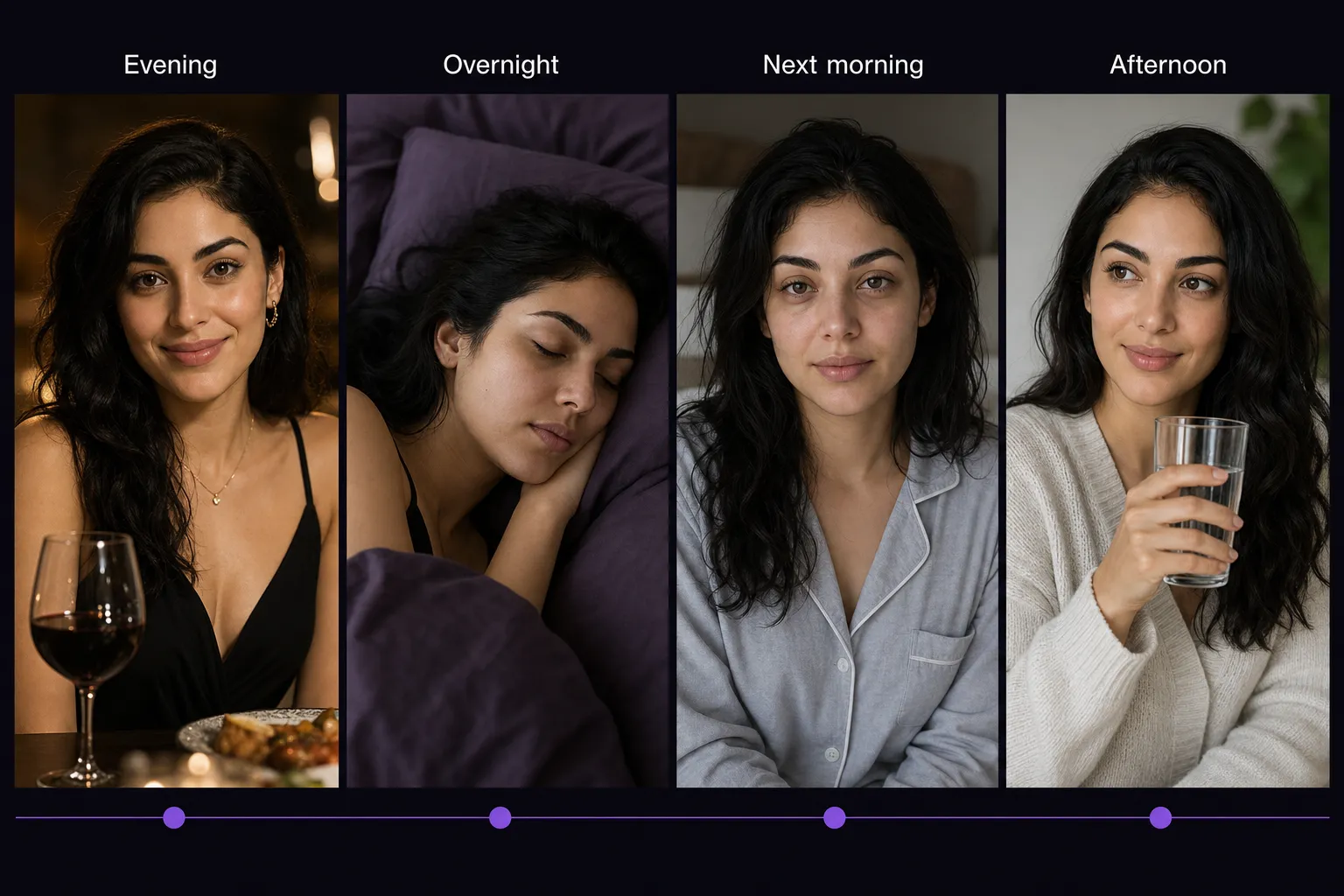
Illustration by DePuff. The timings are general, not a prediction for your face.
- While you drink: you urinate more and start losing fluid. NIAAA
- Overnight: your sleep breaks up. NIAAA Lying flat can let fluid collect around your eyes. Mayo Clinic
- Next morning: hangover symptoms peak when your blood alcohol returns to about zero, and they can last 24 hours or longer. NIAAA This is a common time to notice puffiness, though it varies.
- Later that day: for ordinary waking puffiness, Cleveland Clinic says slight swelling that goes away within a few hours is probably not a cause for concern. No source gives a separate timing for alcohol. Cleveland Clinic
- Past a few days: facial swelling that lingers for more than a few days is a reason to call a healthcare provider, whatever you drank. Cleveland Clinic
No drink, supplement or trick has been shown to cure a hangover; time is what works. NIAAA The routine below cannot speed up how your body clears alcohol. Its aim is smaller: to help move fluid that has settled in your face so you may look and feel less swollen sooner. Results vary.
How to depuff your face after drinking: a 10-minute routine
Do this sitting or standing, not lying down. Use light pressure throughout.
Minute 0 — Drink a glass of water and stay upright. After a night of drinking you may be dehydrated. Keeping your head up also helps, because Cleveland Clinic lists keeping your head elevated among home measures for a puffy face. Cleveland Clinic
Minutes 1–3 — Cool compress. Wet a clean washcloth with cool water. Sitting up, hold it under and around your eyes for a few minutes with light pressure. Mayo Clinic A cold compress helps with swelling. Cleveland Clinic Do not press on your eyes.
Minutes 4–9 — Lymphatic self-massage. This short sequence follows Cleveland Clinic's guide. Their massage therapist says it is "great if you wake up a little puffy". Cleveland Clinic Move only the skin, not the muscle underneath. For the jaw strokes and the full stroke order, see our full face massage routine.
- Chest: with your right palm, sweep lightly from the middle of your chest toward your left armpit. Switch sides. Repeat 10 times.
- Neck: put your fingertips just below your ears. Make slow circles that move the skin down toward your chest, 5 to 10 times.
- Forehead: circle above your eyebrows, working out to your temples, at least 10 times.
- Cheeks and under-eyes: from the apples of your cheeks, make gentle downward circles 10 times.
- Chest again: repeat the first step 10 times to finish.
Skip it if you have an active infection (wait until you have been on antibiotics for at least a week), cellulitis, blood clots or DVT, cancer, heart disease, kidney disease, tuberculosis or skin damage from radiation therapy. If you have lymphedema, or any doubt, check with a healthcare provider first. Some people feel a little tired, headachy or queasy afterward, so take it easy and keep sipping water. Cleveland Clinic
Minute 10 — Set up tonight. Choose a lower-salt breakfast and lunch. Tonight, sleep with your head slightly raised on an extra pillow. Mayo Clinic
If you want the same idea without planning it every morning, that is what we built DePuff for. The quiz builds you a personalized daily de-puffing routine. The app guides each step (cold therapy, massage and gua sha, illustrated and timed) and tracks the change with a selfie scan. Take the quiz to build your routine. If you prefer to do it by hand, the steps above work too.
How to avoid a puffy face after drinking: the night-of plan
In general, the more alcohol you drink, the worse the hangover, whatever the drink. NIAAA NIAAA measures hangovers, not facial puffiness, so treat this as a guide. A US standard drink holds 14 grams of pure alcohol. A regular 750 ml bottle of wine is about 5 drinks, and one mixed drink or cocktail can be one drink or more. NIAAA
Before bed, these four steps may help you wake up less puffy:
- Count your drinks honestly. Fewer drinks means a smaller hangover. NIAAA
- Go easy on the salty late-night food. Too much salt makes your body retain fluid. Cleveland Clinic
- Raise your head. An extra pillow helps stop fluid from pooling around your eyes as you sleep. Mayo Clinic
- Protect your sleep window. A late night plus an early alarm means broken sleep and less time for it, and sleep changes are one of the effects above.
Is alcohol really the cause of your puffy face? A two-week self-test
Many things make a face look puffy: salt, short sleep, allergies, even the light in your bathroom. Before you blame (or clear) alcohol, test it on yourself.
- Pick your conditions. Choose the same room, light, camera distance and relaxed expression. Take each photo within 30 minutes of waking, before coffee or ice. Our morning depuffing guide explains how to take comparable photos.
- Log four things each morning: drinks the night before (as standard drinks), a rough salt level of dinner (low, normal or high), hours slept, and a puffiness rating of 1 to 3 (less, usual, more).
- Run two weeks. Include at least three mornings after drinking and three alcohol-free mornings with similar sleep.
- Compare like with like. Look at a drinking morning next to an alcohol-free morning with similar sleep and salt. If those two look different, alcohol may be part of your pattern. If they look the same, look harder at sleep and salt.
This is a personal record, not a medical test. Photos vary, and one person's two weeks cannot prove a cause. It is still more useful than guessing in the mirror.
What changes when you cut down or stop drinking?
Drinking less means less of the effects listed above, so your face may look less puffy, but no source measures this. Dehydration is one reason the body holds on to fluid. Cleveland Clinic How much your face changes, and how fast, varies from person to person. Salt, sleep and your own anatomy still count, and no reliable source gives a day-by-day timeline for your face. For people who have drunk heavily, the liver can often recover in the early stage of alcohol-related liver disease if they stop drinking. NHS
The honest way to see your own change is to track it. Use the two-week self-test above, or keep it going for longer with the same photo conditions. The DePuff app's selfie scan does the same job for you: it reads five facial measurements, including how much puffiness is masking your features, and puts each scan on a timeline so you compare numbers instead of memories. Start with the quiz.
Normal morning-after puff, a pattern, or a warning sign?
Likely a normal morning after:
- Mild, even puffiness, often around the eyes, the morning after drinking.
- It fades within a few hours of getting up. Cleveland Clinic
- What to do: the 10-minute routine above, then the night-of plan next time.
A pattern to change:
- Puffiness most mornings, and your log links it to drinking, salt or short nights.
- Friends or family comment on your drinking, or you want to cut down.
- What to do: reduce the amount and track the effect with the two-week test. If you drink heavily every day, talk to a doctor before you stop. If you regularly drink too much, stopping suddenly can be very dangerous. NHS
A warning sign, not a hangover:
- Swelling that lasts more than a few days, appears suddenly, or comes with severe pain. Cleveland Clinic
- Yellow skin or yellow whites of the eyes, a swollen tummy or swollen legs. These can be signs of alcohol-related liver disease. NHS
- What to do: see a doctor. A depuffing routine is the wrong tool here.
Get emergency help now for sudden swelling of the lips, mouth, tongue or throat, or any difficulty breathing or swallowing. These can be signs of a serious allergic reaction. NHS: angioedema
Quick answers
Does a puffy face mean someone is an alcoholic?
Not on its own. One puffy morning after a night out is common, and many things can make a face puffy. Cleveland Clinic Yellowing skin or eyes, a swollen tummy or swollen legs are reasons to see a doctor about liver health. NHS If you are worried about your own or someone else's drinking, a doctor or an alcohol support service is a better guide than a mirror.
Does beer, wine or liquor make your face puffier?
Mostly, the amount matters more than the type. NIAAA notes that hangovers get worse the more a person drinks, whatever the mix. Darker spirits such as bourbon contain more congeners, which could worsen hangover symptoms for some people. NIAAA NIAAA measures hangover symptoms, not puffiness, so treat this as a guide. What you eat with your drinks and how late you stay up also affect how you look the next morning.
Why does my face get puffy after drinking when my friends' faces don't?
People react differently to the same drinks, and how many drinks cause a hangover is hard to predict. NIAAA Some people also flush red when they drink (the ALDH2 reaction above), so their face changes in a different way. Salt, sleep and how many drinks each of you actually had can explain the difference too. The two-week test shows how you respond.
Is alcohol puffiness permanent?
Mild waking puffiness that goes away within a few hours is probably not a cause for concern. Cleveland Clinic Swelling that stays for days is a different problem and needs a doctor. With regular heavy drinking, swelling of the tummy or legs can be a sign of liver disease. NHS
Why is my face puffy after drinking but my body isn't?
Mayo Clinic says fluid can collect around your eyes when you lie flat, and that sleeping with your head slightly raised helps prevent it. Other causes such as salt, sleep and allergies may play a part too. Mayo Clinic Facial swelling is a buildup of fluid in the tissues of the face. Cleveland Clinic
The short version
Alcohol may leave your face puffy because it makes you lose fluid, disrupts your sleep and adds to inflammation. Ordinary waking puffiness often eases within hours, even when the rest of a hangover lasts longer. For the morning after, use cold, a light drainage massage and an upright start. For next time, drink less, eat less salt and raise your pillow. If the puffiness keeps coming back, track it for two weeks. If your face stays swollen for days, see a doctor.
If you want a routine that does this every morning without guesswork, start with the DePuff quiz below. It builds your personalized daily de-puffing routine.
Sources
- National Institute on Alcohol Abuse and Alcoholism: Hangovers; Rethinking Drinking
- Cleveland Clinic: Facial swelling; Moon face; Lymphatic drainage self-massage; Alcohol flush reaction
- Mayo Clinic: Bags under eyes, lifestyle and home remedies
- NHS: Alcohol-related liver disease; Angioedema