 DePuff
Facial lymphatic drainage may temporarily ease mild, even puffiness caused by fluid, but it is not a proven treatment for everyday morning puffiness. We found no trial that tested it for everyday puffiness in healthy people. The closest evidence is small, mixed trials after jaw or wisdom-tooth surgery, plus roller and gua sha studies that measured blood flow or face contours instead. It does not remove fat, change bone or permanently sculpt a jawline. Cleveland Clinic, SELF's expert roundup
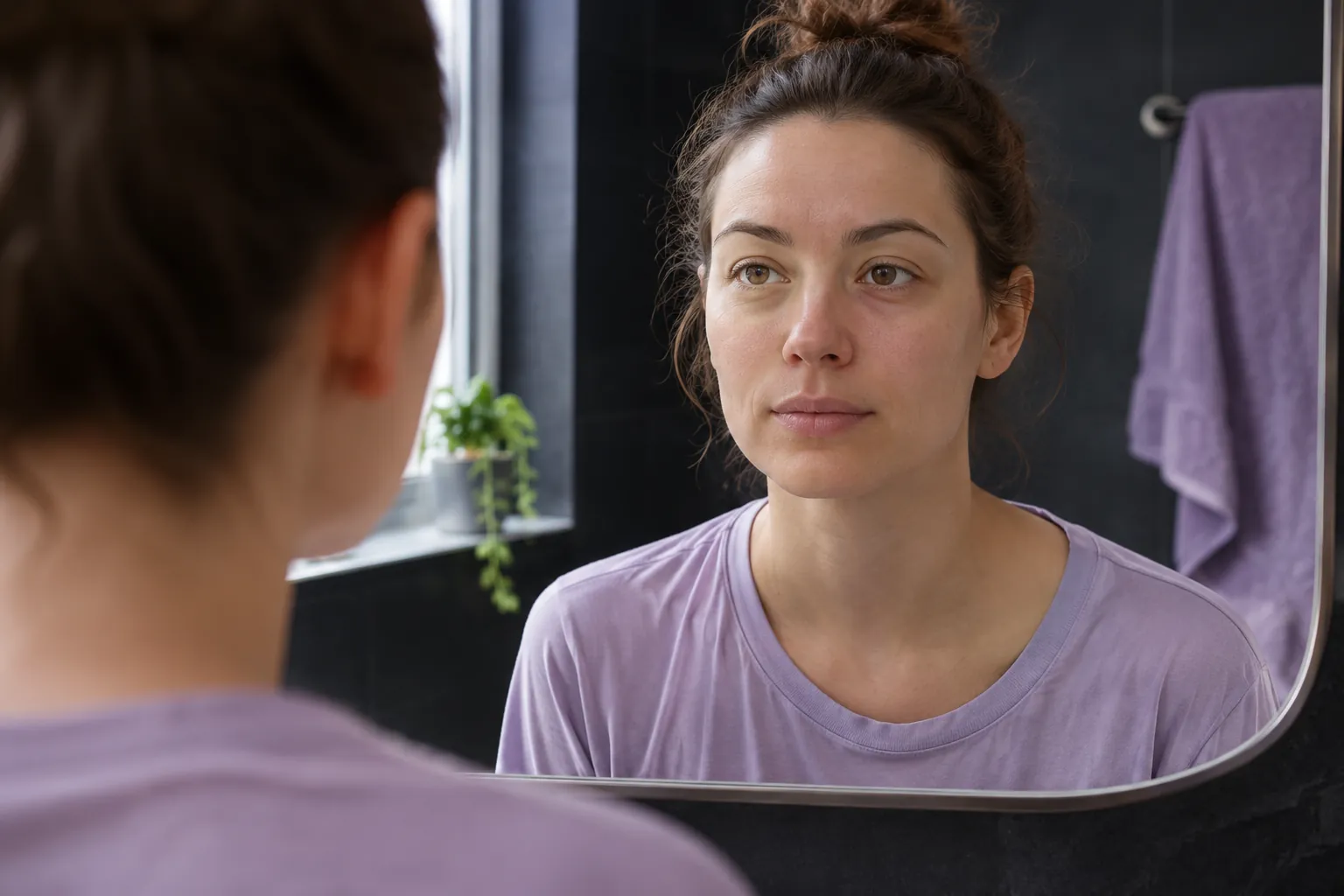
Illustration by DePuff. Not a real before-and-after.
Worth trying? A short home session can be a reasonable experiment for familiar morning puffiness if the safety box below does not apply. Before buying a tool or booking several facials, decide what would make the effort worthwhile: a visible difference, a pleasant ritual, or both. Those are separate outcomes.
What is a lymphatic drainage facial actually doing?
Manual lymphatic drainage, often shortened to MLD, uses gentle movements to encourage excess tissue fluid toward lymph vessels and nodes. These vessels sit close to the skin, which is why the technique uses a very light touch. Deep kneading is a different kind of massage. Cleveland Clinic's self-massage guidance
The medical use is chiefly for lymphedema, where disrupted lymph transport causes swelling. Massage can be part of its treatment plan. Booking a "lymphatic drainage facial" does not mean you have a lymphatic problem. Cleveland Clinic's treatment overview
For an appearance goal, define “working” before judging a result. Less visible fullness, warmer skin and feeling relaxed are different observations. A photo can help record the first; it cannot tell you how much lymph moved or why your face changed.
What did the studies actually measure?
These five studies are relevant to facial massage, but they answer different questions. The first two studied rollers or gua sha. The other three tested manual lymphatic drainage (MLD) after jaw or wisdom-tooth surgery. In the table, n means the number of participants, not the number of cheeks or treatments.
| Claim | What was measured | n | Verdict |
|---|---|---|---|
| A roller boosts facial circulation | Miyaji, 2018: skin blood flow after five minutes of rolling the right cheek; separately, the response to local heat after five weeks of daily rolling. | 12 in the short-term arm; 14 in the five-week arm | Blood flow rose only in the massaged cheek for at least 10 minutes after the short session. The longer intervention improved heat-induced vasodilatation there. Neither arm measured puffiness. Coauthor Sugimori was affiliated with the Research and Development Center at MTG Co. Ltd., a beauty-device company. Study |
| Tool massage changes facial contours | Ahn, 2025: facial surface distances, muscle tone and skin elasticity after roller versus gua sha use for 10 minutes, five days a week, for eight weeks. | 34 women enrolled, 17 per group; 33 completed | Contour distances fell 2.23–2.40 mm with gua sha and 2.75–3.26 mm with the roller. There was no untreated group, and puffiness was not measured. These millimeters are not measured depuffing or fat loss. Study |
| MLD reduces swelling after jaw surgery | Yaedú, 2017: facial tape measurements, photographs and patient ratings after double-jaw surgery. MLD plus usual care was compared with light placebo massage plus usual care. | 30 | There was no difference in peak swelling or the day it peaked. Tape measurements showed faster, greater swelling regression, but patients reported no difference in swelling or pain. A measurable change did not translate into a noticed benefit. Study |
| More MLD sessions improve jaw-surgery recovery | Van de Velde, 2020: 3D facial scans and questionnaires after six MLD sessions versus none, with usual postoperative care in both groups. | 26; 13 per group | No statistically significant difference in swelling or pain. The observed faster decrease in the MLD group was not enough to establish a treatment benefit. Study |
| MLD helps after wisdom-tooth extraction | Ulu, 2025: 3D swelling measurements, pain ratings and mouth opening in a split-mouth trial. Each patient's two lower wisdom teeth were removed two weeks apart. A physiotherapist used Vodder MLD after the treated extraction: a 40-minute session on surgery day, then two more sessions over the next two days. | 46, aged 18–26 | The MLD side had significantly less swelling, pain and trismus (restricted mouth opening) on days 3 and 7. This was postoperative treatment with far more hands-on time than a home routine. Study |
Read the verdict column before borrowing a study's headline. A circulation result cannot answer a swelling question, and comparing two active tools cannot show what would have happened without either one. The surgical studies also concern injured, healing tissue. Their results do not supply a dose or success rate for your morning mirror check.
Does it help morning puffiness or puffy eyes?
Morning facial fullness can reflect normal overnight fluid retention. Too much or too little sleep can make it more noticeable. Under-eye fluid retention is also common after a salty meal. Cleveland Clinic: facial swelling, Mayo Clinic: under-eye bags
Cleveland Clinic's self-massage guidance describes facial drainage as an option for waking up a little puffy. Cleveland Clinic's treatment overview also says people without lymphedema may not see meaningful results. Together, that supports trying it with modest expectations, rather than assuming everyone needs it. Self-massage guidance, treatment overview
For under-eye puffiness, Mayo Clinic suggests a cool, damp washcloth while sitting upright, enough sleep, less salt and a slightly raised head at night. These are useful options if massage does not appeal to you. Mayo Clinic's home care Our guide to puffy eyes when you wake up covers that area in more detail.
Is a puffy face a sign of poor lymphatic drainage?
Usually not. "Poor lymphatic drainage" is not something you can diagnose from a puffy morning selfie. In a healthy face the lymphatic system already works on its own, and massage may at most help it along a little faster. SELF's expert roundup Online, the phrase usually lumps together two different things:
| Overnight fluid pooling | A medical lymphatic problem (lymphedema) | |
|---|---|---|
| What it is | Normal fluid retention while you sleep, often more noticeable after too much or too little sleep or a salty evening | A diagnosed condition in which lymph transport is disrupted. Cleveland Clinic notes it often follows cancer surgery |
| Typical pattern | Even, familiar fullness on waking | Persistent swelling a clinician has diagnosed |
| Who decides | You can watch it with the seven-day check below | A clinician |
| Role of massage | An optional home experiment | Part of a clinician's treatment plan, not a beauty routine |
Cleveland Clinic: facial swelling, Cleveland Clinic: lymphatic drainage, Mayo Clinic
Swelling that is sudden, one-sided, painful, hot or getting worse fits neither column. Follow the safety box below instead of massaging.
Describe what you notice instead of naming a malfunction: both cheeks or one side, only on waking or throughout the day, familiar or new. That description is more useful when deciding what to do next. Our guide to possible causes of a puffy face helps organize those observations.
Who is it worth trying for, and who should skip it?
Use this table to choose a next step. It combines the clinical guidance above with the trial limits; it is not a diagnostic checklist.
| What you notice | Is massage a useful option? | Better next step |
|---|---|---|
| Familiar, mild, even fullness on waking | An optional home experiment | Use the matched-time photo check below to decide whether it earns a place in your morning. |
| Puffiness after salty food or a night of drinking | Optional, but it won't change what caused it | Record meals, alcohol and sleep together; see the guide to puffiness after drinking. |
| Persistent under-eye bags involving loose tissue or fat | Not a way to reposition fat or restore tissue support | If they bother you, ask a doctor about options. Massage will not move fat back. Mayo Clinic |
| Unexplained or one-sided swelling | Skip the home experiment | Follow the safety box. |
| Diagnosed lymphedema | Potentially part of medical care | Use your clinician's plan; a beauty facial is not a substitute. |
| Recent jaw, dental or facial surgery | A question for your surgical team | Ask whether MLD fits your procedure and recovery before booking or trying it. |
When to skip massage and get help
Call 911 (or your local emergency number) if your lips, mouth, tongue or throat suddenly swell, your throat feels tight, or breathing or swallowing becomes difficult. NHS: angioedema
Get medical advice instead of massaging unexplained, sudden or one-sided swelling. Seek prompt care for pain, hot skin, fever or spreading color change, or swelling that persists or worsens. Cleveland Clinic: facial swelling
Skip DIY drainage if you have an active illness or infection (including cellulitis or tuberculosis), a fever, blood clots or DVT, heart disease, kidney disease, or have had a stroke. If you have lymphedema, talk to your clinician before trying it. Do not massage over cancerous tissue or radiation-damaged skin. Cleveland Clinic: safety, self-massage precautions
Stop if it hurts. Fatigue, headache or nausea can occur afterward; rest and seek advice if symptoms persist. Cleveland Clinic
Will it sculpt my jawline or give me a facelift?
There is no evidence here that facial lymphatic drainage removes fat, changes bone or produces a permanent facelift. "Detox" is not an established cosmetic outcome either. If your skin looks brighter afterward, experts quoted by SELF put that down to increased blood flow from handling the skin, not toxin removal. That fits the Miyaji roller study, which measured blood flow and not swelling. A temporary appearance change should not be sold as structural remodeling. Expert discussion of facial-drainage claims
When judging a dramatic before-and-after, look at camera height, lighting, head position and expression before judging the treatment. If those conditions changed, the pictures cannot isolate what the massage contributed. Even a consistent pair needs context: how long after waking was each photo taken, and what else happened between them?
How long do results last, and can I do it every day?
The reviewed studies do not establish how many hours everyday facial depuffing lasts, or an optimal schedule for it. If nothing in the safety box applies, a gentle daily session is low risk; Cleveland Clinic says lymphatic drainage is not dangerous in most cases. But daily use is not a proven requirement, and no study shows that more often works better for everyday puffiness. treatment overview Choose a brief routine you can evaluate comfortably; more sessions are not automatically a better experiment.
Keep two questions separate: “Did today's session seem useful?” and “Are my mornings changing over time?” The first is about an immediate effect; the second includes everything happening between mornings. For broader expectations, see how long face debloating can take.
Should I use my hands, buy a tool or book a facial?
Hands are a practical starting point because they require no purchase. Cleveland Clinic teaches facial self-massage without a device. Home technique guidance For stroke order and timing, use our five-minute lymphatic drainage face massage.
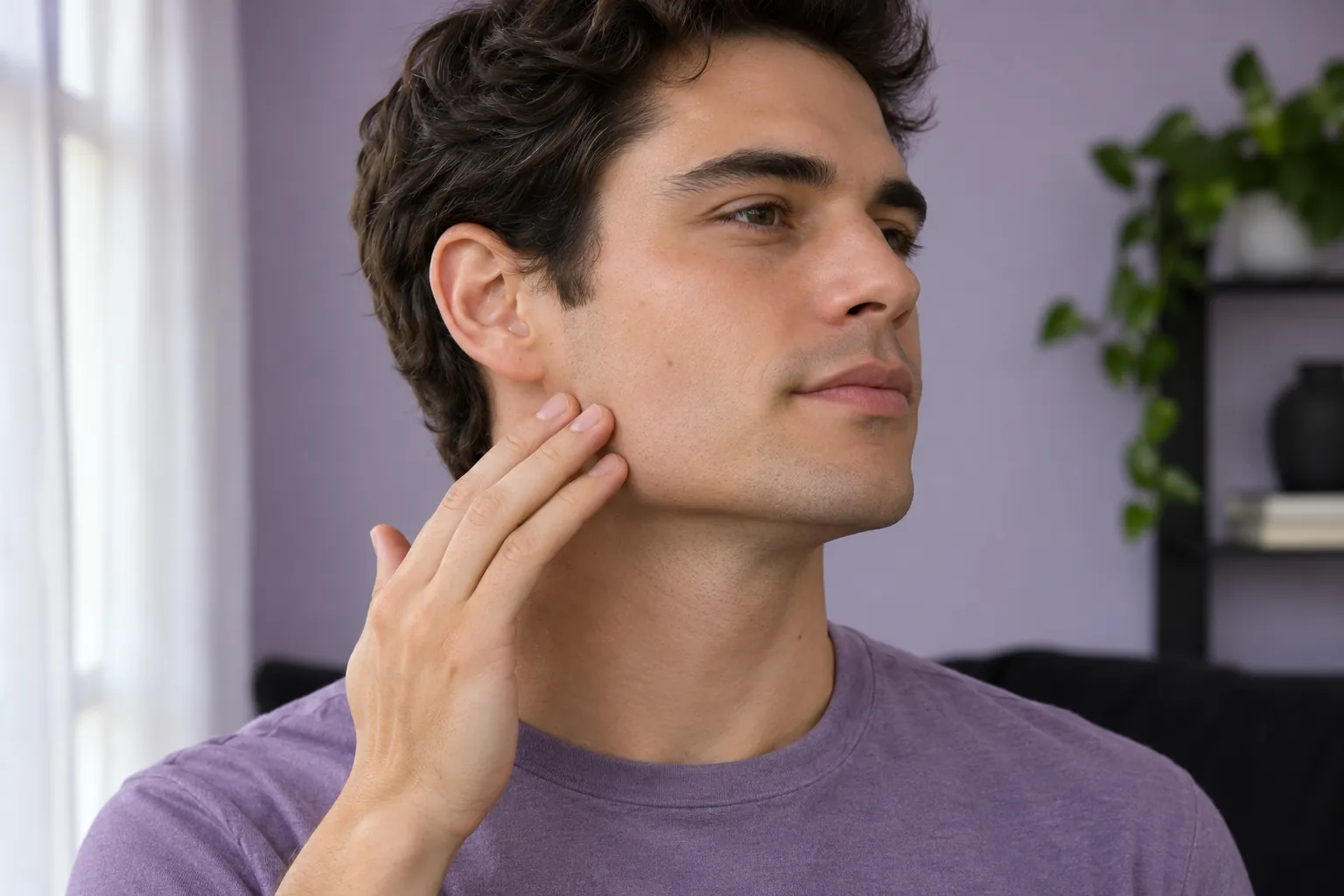
Illustration by DePuff. Pressure should stay so light you never feel muscle underneath.
If you prefer a tool, our gua sha evidence verdict explains what its research supports. Choose for comfort and convenience; the evidence above supplies no everyday-depuffing winner.
A salon appointment may be something you enjoy, but these studies do not show that a cosmetic facial outperforms home care for ordinary puffiness. Before paying, ask what the session includes, who performs it and what outcome they promise. Decide whether the experience itself justifies the cost, without counting on a transformation.
How can I tell whether it helps me over seven days?
Use this observation plan for familiar, mild puffiness. The schedule is our comparison method, not a validated treatment dose or a seven-day results promise.
- Fix the photo setup. Use the same room, light, lens, camera height and distance. Keep your head position and expression relaxed. Turn off filters and beauty modes.
- Choose matched times. For example, photograph at 20 and 35 minutes after waking every day, before skincare. These intervals keep comparisons consistent; they have no special treatment significance.
- Choose session days in advance. Try the same brief massage between photos on days 2, 4 and 6. On days 1, 3, 5 and 7, take both photos without massage. Keep other steps the same; avoid adding a cold tool or compress between pictures.
- Keep one short note. Record sleep, salty meals, alcohol, new products and whether you massaged. Write “less,” “similar” or “more” for visible fullness, and record comfort separately.
- Review all seven days together. Compare the two pictures within each morning, then compare first pictures across mornings. Keep missing or mismatched photos labeled rather than substituting a better-looking one.
- Read the pattern, not one morning. If the change between your two photos is noticeably bigger on massage days (2, 4, 6) than on no-massage days (1, 3, 5, 7), the massage may be adding something for you. If the changes look about the same, the normal morning decrease is probably doing most of the work.
Fictional example — not a DePuff user result or a clinical test:
| Day | Matched photos | What happened | Interpretation |
|---|---|---|---|
| 3, no massage | 20 and 35 minutes after waking; same setup | Jordan records slightly less cheek fullness in the second photo | A similar change on a massage day would not, by itself, show that massage caused it. |
Including mornings without massage gives you a more useful comparison than collecting only your best after photos. It still cannot control every influence or diagnose the cause of puffiness. If a difference is hard to see consistently, record that honestly; enjoying the routine is a separate reason to keep it.
If you would rather organize a broader morning plan, start with our everyday depuffing routine. For guided daily steps and face-scan tracking, DePuff offers a personalized routine. Build my routine.