 DePuff
Creatine can add water weight early, especially during loading, but that short-term retention is mainly linked to water inside muscle cells, and none of the studies reviewed here measured facial puffiness, so a “creatine face” is not established. A puffier face after starting it could also reflect ordinary overnight fluid retention or changes in sleep, so the timing alone cannot identify the cause. Creatine evidence review, Cleveland Clinic
Short answer
- Water weight can rise: especially during loading, with short-term retention mainly inside muscle cells. Evidence review
- “Creatine face” is not established: none of the studies reviewed here measured facial puffiness. A scale increase is not proof of cheek swelling.
- Start with grams and dates: check your total daily intake and loading dates. For familiar mild morning puffiness, use the seven-day photo-and-habit check below; for new or unusual swelling, read the safety box first.

AI-generated illustration of a fictional adult.
Does creatine make your face puffy or just your muscles fuller?
Three different experiences often get called “bloating”:
- Muscle water: extra water drawn into muscle cells along with creatine; it can show on the scale, but it is not fat. Evidence review
- Stomach symptoms: discomfort in the gut, a separate observation from cheek fullness.
- Facial swelling: fluid collecting in facial tissues, as defined by Cleveland Clinic.
One does not establish another. A higher scale reading cannot tell you where water went, and stomach discomfort does not explain a swollen cheek.
For example, an eight-week trial in 27 resistance-trained men compared creatine with placebo during training four times a week. Muscle mass, total body water and water inside cells increased more with creatine. Water outside cells increased similarly in both groups, and the muscle-to-intracellular-water ratio stayed unchanged. That supports water increasing alongside muscle; it does not establish a cosmetic result.
A loading study in 16 men and 16 women randomized participants to creatine or placebo. The creatine group took 25 g daily for seven days, then 5 g daily for 21 days. Body mass and total body water rose in that group (the placebo group's total body water also rose slightly), while the distribution of fluid between compartments did not change. That was whole-body water, not a face measurement.
Does creatine bloating affect women differently?
There is relevant research in women, and it complicates the claim that all extra water stays inside muscle.
A 2023 randomized trial included 30 moderately active women, some naturally menstruating and some using hormonal contraception. Fifteen received creatine monohydrate as four 5 g servings daily for five days; 15 received placebo, with testing across menstrual phases.
Body-weight change did not differ significantly between supplement groups. The researchers measured body water, not cheeks.
Because the trial included only women, it cannot show whether women respond differently from men. It does show that, in the luteal phase, loading raised fluid outside cells as well as inside them. For someone tracking appearance, cycle timing is useful context to record. This small loading study does not establish that women get “creatine face,” or that a particular cycle phase predicts it.
Does creatine add face fat?
The evidence does not support creatine increasing body fat. Antonio's review examined randomized trials lasting from one week to two years and found that they did not support fat gain from supplementation. Those results were about overall body composition, not direct measurements of facial fat. Evidence review
That distinction helps if you started creatine during a bulk. Record the diet change as well as the supplement: “my weight rose while taking creatine” does not mean every pound came from creatine, or that it all represents the same tissue.
Likewise, the studies here provide no basis for a promise that creatine burns cheek fat or permanently changes your face width. A selfie cannot separate fat from fluid.
How long does creatine face bloating last?
There is no measured facial-puffiness countdown in this evidence. The six-day and 28-day results in Hultman’s study describe how quickly muscle creatine rises, not when a puffy face clears.
The review reports that loading with 20 g daily for five to seven days typically adds 1–3 kg (about 2–7 lb) of body mass, mostly from water. This is a review estimate, not a forecast for every person. Antonio, 2021
Loading versus no loading: days 0–30
The table follows Hultman's study of 31 men across several dosing protocols. It is a muscle-creatine timeline, with observation checkpoints added for convenience. These are research doses, not an individual prescription.
| When | Loading route studied | No-loading route studied | Useful observation |
|---|---|---|---|
| Day 0 | Before supplementation | Before supplementation | Optional baseline photo and weight under repeatable conditions. |
| Days 1–6 | 20 g daily for the six-day loading period. | 3 g daily begins the gradual route. | Record actual grams and any symptoms; do not infer cheek swelling from scale weight. |
| Day 7 | Muscle creatine was about 20% higher after six days; the maintenance protocol then used 2 g daily. | The 3 g daily protocol continued. | Note when loading ended so later comparisons have context. |
| Days 8–27 | The study's maintenance dose sustained the elevated concentration. | The slower protocol continued toward its day-28 measurement. | Keep the photo setup consistent; these dates are not facial recovery deadlines. |
| Days 28–30 | Still in the 2 g daily maintenance phase; the study continued it for a further 30 days after loading and reported the elevated concentration was maintained. | At day 28, muscle creatine was also about 20% higher. | Similar muscle concentrations do not establish identical facial appearance. |
The 2 g maintenance dose belongs to that particular study. The ISSN position stand says loading may be the quickest way to raise muscle stores, followed by 3–5 g daily to maintain them, and lists 3 g daily for 28 days as a slower alternative. The Antonio review goes further: it says loading is not required.
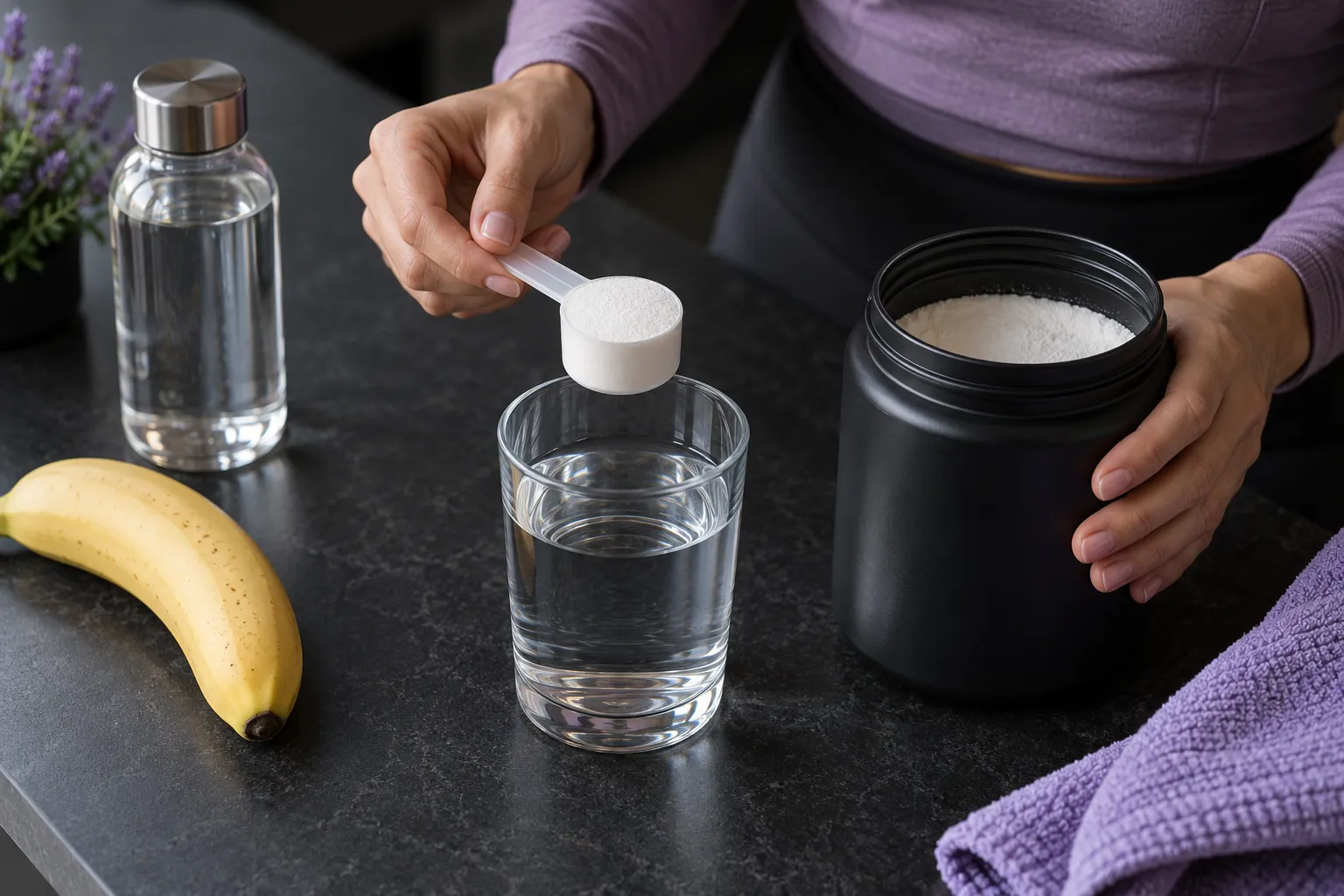
AI-generated illustration; scoop size does not establish a dose.
What if you stop? In Hultman's protocol without maintenance, muscle creatine gradually declined and was no different from its starting level 30 days after supplementation ended. That is a muscle-store result, not a promise about when your face will change. For broader expectations, see what a face-debloating timeline can tell you.
Is it creatine, salt, sleep, alcohol or fat?
Start with what changed and when. This table helps organize observations; it cannot diagnose the cause.
| What changed? | What to check next | What this cannot prove |
|---|---|---|
| New creatine use plus an early scale increase | Daily grams, loading dates and other supplements; compare with the research timeline above. | That extra body water reached your face. |
| Puffiness mainly on waking, alongside shorter or longer sleep | Record sleep and compare morning photos at the same interval after waking. | That sleep is the only cause or that improvement rules out a medical problem. |
| More takeout, unusually salty meals or alcohol that week | Add meals and drinks to the log; return to ordinary meals rather than changing everything at once. | Which ingredient or habit explains the difference. |
| Gradual weight changes alongside a new diet or training plan | Look at the longer weight trend and record the broader plan. | Whether cheek fullness is fat, fluid or something else. |
| A new medicine or product, itching, pain or one-sided swelling | Note the onset and symptoms; use the care guidance below. | That this is a normal loading effect. |
The sleep row follows Cleveland Clinic's guidance: too much or too little sleep can make facial swelling more pronounced. It also identifies allergies, infections and drug reactions among possible causes. Our guide to other reasons your face may look puffy covers those possibilities without assuming a supplement is responsible.
If the change is mainly puffiness around your eyes, focus your notes on that area instead of calling every change whole-face bloating. Avoid assigning yourself the label “moon face” from a creatine post; read what “cortisol face” actually means before treating those names as interchangeable.
What can I do instead of quitting creatine?
For a mild appearance concern, there are useful checks before making an all-or-nothing decision.
1. Count grams, not just scoops. For each product, multiply the labeled grams of creatine per serving by the servings taken, then add the totals. Include any shake or pre-workout that contains creatine. Keep the ingredient lists with your notes.
2. Reconsider whether you need rapid loading. The slower route above gives you a choice about speed, though 3 g or 5 g is not a proven puffiness-free dose. The review specifically says loading is unnecessary, and names daily maintenance dosing as a viable option for people trying to avoid the weight gain that can sometimes occur during loading. Antonio, 2021
3. Separate stomach trouble from the mirror question. Antonio's review notes that servings above 10 g may cause gastrointestinal distress, including diarrhea. The ISSN loading protocol divides the daily amount into four 5 g servings. Those are dosing observations, not treatments for facial swelling.
4. Keep ordinary hydration and meals. Do not restrict water, force extra liters or use a sauna to chase a sharper photo. There is no facial-treatment result in these studies that justifies manipulating fluids. Normal hydration is compatible with creatine use; the review does not support the claim that creatine itself causes dehydration. Evidence review
5. Use simple comfort measures for familiar morning puffiness. Keep your head elevated and place a cold compress on your face, two measures Cleveland Clinic lists to ease facial swelling. Our gentle morning depuffing routine puts those steps in order. They are symptom-relief measures, not methods for flushing creatine from muscle. Clinical guidance
Buying another formula is not the obvious next step. Monohydrate is the most extensively studied form; claims that alternative forms deliver more creatine to muscle are unsupported in the ISSN review. Micronization, complete dissolution and post-workout timing have not been established as facial-puffiness fixes in the evidence reviewed here.
Can I trust creatine face before-and-after photos?
A pair of photos is useful only with context. If one was taken close to the camera at breakfast and the other farther away under gym lighting, you cannot isolate a supplement effect—even if the caption gives exact dates.
A seven-day matched-photo self-check
This is our observation plan, not a study, diagnosis or seven-day results promise. It documents familiar mild puffiness; it also ends well before the slower study protocol reached its day-28 measurement.
Set up once. Choose the same room, fixed light, camera lens, distance, height, head angle and relaxed expression. Turn filters off. Choose a repeatable interval after waking, such as 20 minutes, before a compress or skincare routine.
Days 1 and 7: take the matched photos. If useful, add a photo at the same later time on both days. Compare morning with morning and later with later. Label any picture taken under different conditions rather than quietly treating it as equivalent.
Every day: make a one-minute note. Record:
- Daily creatine grams, servings, days since starting and whether you are loading.
- Sleep duration and wake time.
- Usual or unusually salty meals; alcohol, if any. Our guide to facial puffiness after drinking covers that separate question.
- Cycle timing, if relevant; new medicines or products; any symptoms.
- Optional same-time scale weight and a simple description: less, usual or more puffy.
Keep normal fluids and ordinary meals; do not deliberately provoke a reaction for the log. Photos and weigh-ins are optional if they make you anxious.
On day 7, read the sequence. Did the appearance change repeat under matched conditions? Did several habits change together? Pick one manageable routine habit to work on, such as a consistent bedtime, and label that change in your notes. The record can reveal a pattern without proving its cause.
A worked example (fictional)
Jordan starts a loading protocol during a week of late nights and takeout. The “before” photo is an afternoon picture by a window; the “after” is a close morning selfie. Jordan's cheeks look different, but the two pictures cannot answer the creatine question.
Jordan records the loading dates and switches to matched morning photos. The useful conclusion is: “I noticed a change during a week when several things changed.” There is no invented transformation here, just a better record to guide the next step.
If organizing those daily habits is the hard part, DePuff's quiz builds a personalized daily de-puffing routine, with face-scan tracking in the app. Build my routine.
When should I get facial swelling checked?
Do not wait for loading to finish when swelling needs care. Seek emergency help for facial swelling with difficulty breathing or swallowing. Contact a healthcare provider for sudden swelling, severe pain, itching, signs of infection such as fever or tenderness, or swelling that persists beyond a few days or worsens. Random, unexplained swelling also warrants care. Cleveland Clinic lists tooth abscesses and salivary gland problems among the causes of swelling on one side of the face. Cleveland Clinic
Have kidney disease? Talk with your healthcare team before using creatine; research in this group is limited. Bring your supplement label and medication list when discussing symptoms, and ask your prescriber before changing any prescribed medicine. Mayo Clinic, Cleveland Clinic