 DePuff
Putting chilled cucumber slices on your closed eyes acts like a cool compress and may temporarily ease mild puffiness. The cold likely does most of the work; the evidence reviewed here does not show that cucumber works better than a clean cool cloth. Johns Hopkins Medicine, Mayo Clinic.
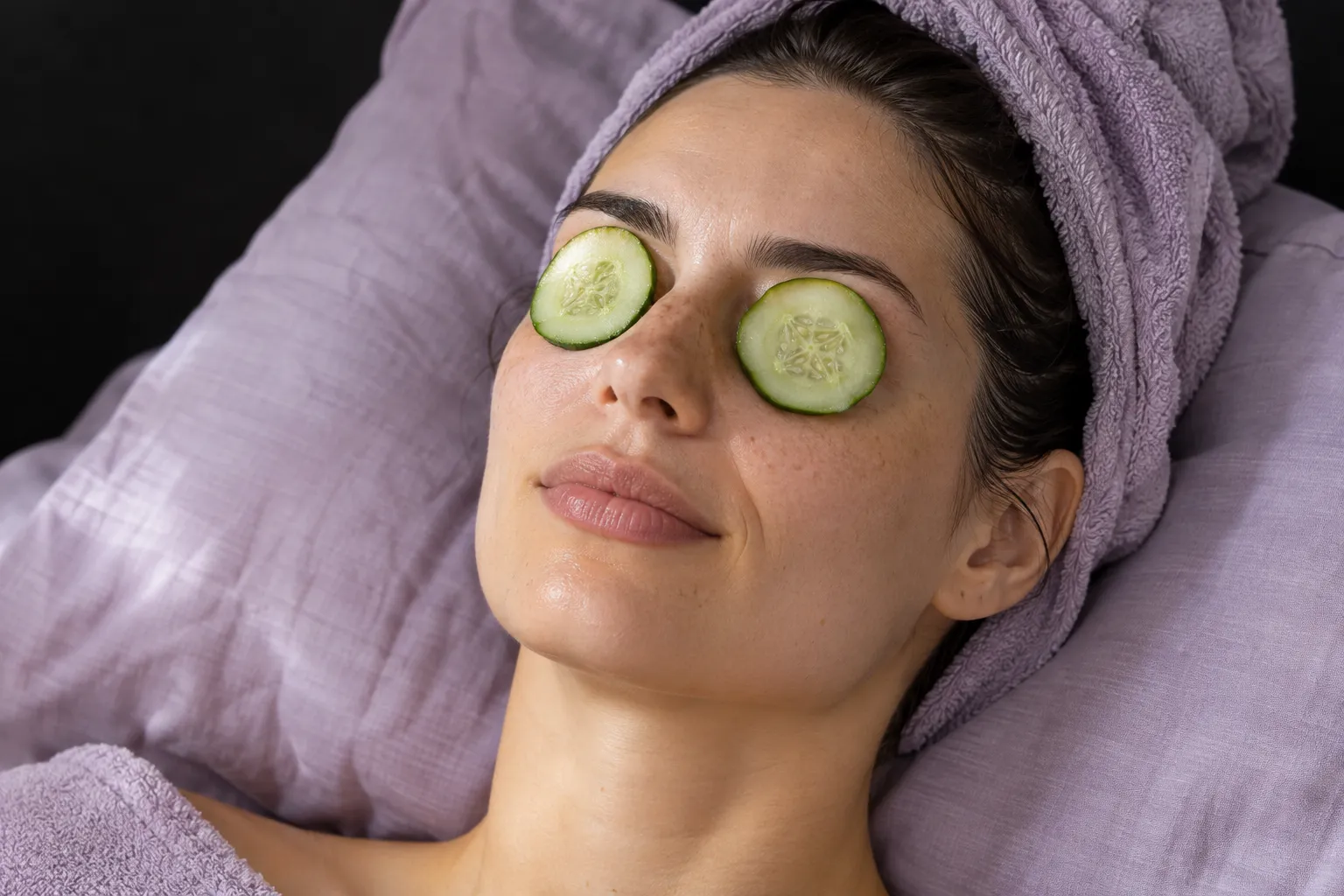
AI-generated illustration of a fictional adult.
How long? A few minutes, while the slices still feel cool. We suggest about three minutes; that is our practical pick, not a tested dose. You do not need to reach a 10- or 15-minute target. Below: what this trick can and cannot change, and how to pick the simplest option for your morning.
What do cucumbers on your eyes actually do, and why cucumbers?
Cooling reduces local blood flow, which can lessen swelling. Johns Hopkins includes chilled cucumber slices and refrigerated spoons among its home cold-compress options. That supports using something cool; it does not establish a special cucumber ingredient effect. Johns Hopkins Medicine.
Cucumber is convenient: slices are soft, damp and easy to rest over closed lids. Raw cucumber with peel is about 95% water, according to USDA FoodData Central. Its vitamin content is often used to explain more ambitious beauty claims, but food composition does not tell us how much reaches the skin or whether that amount changes its appearance.
The frequently cited 2013 cucumber review discusses soothing skin uses and cucumber juice. It is a review, not a controlled trial of slices on eyelids. Research on juice, extracts or formulated products cannot supply a result for two slices from your refrigerator.
You may also read that ten minutes of cucumber visibly reduces puffiness, with a paper titled “Effective Home Remedies that Provide Quick Relief for Puffy Eyes” given as the source. Its abstract describes an online questionnaire of 120 people, not a timed cucumber treatment. Sixty-one of them said they deal with puffy eyes, and only 23 of those did anything about it. Eleven of those 23 named cucumber among the remedies they found most effective, and most said their remedies worked “sometimes”. That is what people reported, not a measurement, so it cannot establish that ten minutes produces a visible change.
So choose cucumber if you enjoy the feel and already have one. There is no demonstrated need to buy it specially for your eyes.
How long should you leave cucumbers on your eyes?
Johns Hopkins suggests a few minutes of cooling over closed eyes. Common 10–15-minute cucumber recommendations are not an established optimal dose: the sources reviewed here contain no controlled raw-slice study that identifies the best exposure time.
Once the slices warm up, remove them, or flip them once if the other side still feels pleasantly cool. You do not need repeated replacements to keep a timer running.
Can you leave them on overnight? No—remove them before sleeping. None of the sources reviewed here shows an extra benefit from overnight use, and it turns a brief step you can watch into hours of contact while you sleep.
Every day? Daily use is optional if your skin tolerates it and you find it worthwhile. There is no established cumulative benefit or number of days after which cucumber should start working. Judge the immediate experience instead of committing to weeks of use in anticipation of a transformation.
How do I put cucumbers on my eyes, step by step?
Check the safety box below first. Keep a fresh cucumber in the refrigerator so it is already cold. With washing and cleanup, the whole thing fits in about ten minutes. The slices are on your eyes for only a few of them.
- Prepare. Wash your hands and rinse the cucumber under running water before cutting or peeling. Use a clean vegetable brush on its surface, then a clean knife and board to cut two manageable slices. The FDA's produce guidance recommends washing before peeling and says soap or produce wash is unnecessary. Peeling is optional; it does not replace washing.
- Cool for a few minutes. With clean skin, lean back enough to keep the slices in place. Mayo's cloth method is done sitting up, which is one more reason the cloth is the simpler default. Close your eyes and rest one slice over each lid without pressing on the eyeballs. Slice thickness only needs to make them easy to handle; there is no validated half-inch requirement. Take the slices off after a few minutes, or as soon as they stop feeling cool. Flip them once if you like.
- Clean up. Discard the used slices. Rinse away residue if desired, pat dry and return to your usual tolerated skincare. You do not need a new eye cream afterward or another cooling tool to finish the session.
If balancing slices feels awkward, use the cloth option in the comparison below.
Do cucumbers help eye bags, dark circles or wrinkles?
“Puffy eyes” can describe different things. A change in fluid-related fullness is different from changing skin pigment, loose tissue or the shape beneath the skin.
| What you want to change | What cucumber can reasonably offer | What it cannot establish or fix |
|---|---|---|
| Familiar mild fluid puffiness that fluctuates | A cooling step that may make fullness less noticeable briefly | Prevention of the next episode or treatment of its underlying cause |
| Persistent bags involving prominent fat or loose skin | Comfort from cooling; any accompanying fluid puffiness may still vary | Repositioning fat or removing excess skin |
| Dark circles from pigment or under-eye hollows | No demonstrated raw-slice correction | Fading pigment or filling a hollow; a brighter-looking photo does not prove either |
| Fine lines or wrinkles | The damp contact may feel refreshing | Proven collagen growth, restored elasticity or lasting wrinkle reduction |
The fluid-versus-structure distinction follows Cleveland Clinic's eye-bag guidance. The cucumber-specific limits reflect the absence of direct slice evidence in the research above; the cucumber review does not establish those cosmetic outcomes. Several features can coexist, so this is an expectation table, not a way to diagnose your under-eyes. Cleveland Clinic notes that morning fluid build-up can by itself make you look as if you have dark circles. If yours look darker mainly on puffy mornings, they may look lighter once the swelling settles. That is the puffiness changing, not the pigment.
What about vitamin K or vitamin C? USDA lists 16.4 micrograms of vitamin K and 2.8 milligrams of vitamin C per 100 grams of raw cucumber with peel. Those are food nutrient amounts, not an absorbed eyelid dose. Their presence does not demonstrate that slices treat dark circles. USDA record.
If your main problem is repeated swelling after waking, follow the broader guide to why your eyes look puffier in the morning. It covers the overnight habits a cucumber session does not address.
Are cucumbers better than cold spoons, tea bags or a compress?
A clean cool washcloth is the easiest starting choice: no food preparation, hard metal or product purchase. Mayo Clinic recommends dampening one with cool water and holding it lightly under and around the eyes for a few minutes while sitting upright.
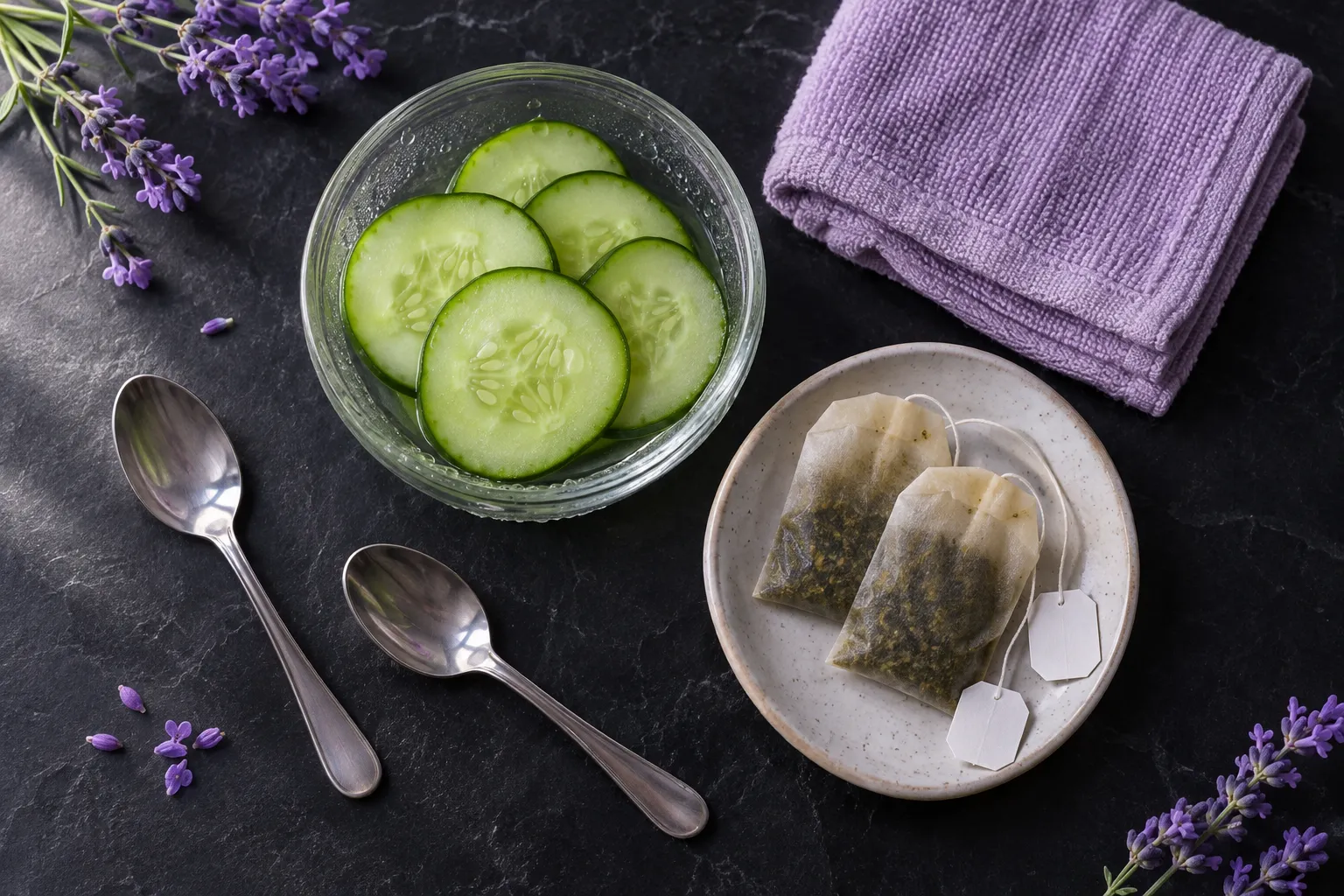
AI-generated illustration of the options. The lavender sprigs are decoration, not ingredients.
This table compares evidence and convenience, not measured winners in a five-way trial.
| Option | Evidence for the choice | Practical tradeoff |
|---|---|---|
| Cool damp washcloth | Mayo's recommended home compress | Easy to adjust and rewet; needs a clean cloth and cool water |
| Chilled cucumber slices | An institutional cold-compress option | Soft contact; requires washing, cutting and discarding food |
| Refrigerated spoons | Another institutional cold-compress option | Reusable; hard surface needs a light touch; use the refrigerator, not frozen metal |
| Chilled caffeinated tea bags | Hospital advice, without a verified comparison showing an advantage over a cloth | Brewing and chilling add preparation; bags can leave residue; keep hot tea and loose leaves away from eyes |
| Caffeine eye gel | A small controlled trial tested one formula; details below | Costs money; choose an eye-area product and follow its directions |
Sources: Mayo Clinic's compress advice, Johns Hopkins' home options, caffeine-gel trial.
In that 2011 randomized, double-blind trial, 34 volunteers aged 19 to 24 had a 3% caffeine gel put on one eyelid and the same gel without caffeine on the other, the morning after a night without sleep. Puffiness went down on both sides. Overall, the caffeine gel did not do significantly better than the plain gel, although 8 of the 34 volunteers responded more to the caffeine side. The authors concluded that the gel's cooling effect mattered more than the caffeine. The trial had no untreated eye, so it cannot show how much of the change was morning swelling settling without help. It is a result for one formula in young adults, not proof that every caffeine product fails, and it tested neither tea bags nor cucumbers. Amnuaikit and colleagues.
If you prefer the familiar spa ritual, cucumber is a reasonable choice within these limits. If you want the least preparation, choose the cloth. For the separate question of cooling your whole face, see the evidence on ice-water face dips.
Can cucumbers irritate your eyes, and who should skip them?
Use this only for familiar, mild puffiness.
Skip cucumber if you have a known cucumber allergy or broken or actively irritated skin. Use fresh, comfortably chilled slices—not frozen, pickled or coated in honey, fragrance or essential oils. Keep food and juice out of the eye. Stop for itching, stinging, burning, pain, numbness or increased swelling. These are practical precautions; “natural” is not a reason to push through discomfort.
Remove contact lenses if your eyes or lids are swollen, as Cleveland Clinic advises. Leaving them out during this optional routine is a sensible precaution.
Arrange an eye assessment for new unexplained one-sided swelling, or for swelling that lasts longer than 24 to 48 hours (Cleveland Clinic). One-sided appearance alone is not automatically an emergency. Seek urgent care for eye pain, a swollen lid that is red, hot or painful, difficulty opening the eye, fever with eye symptoms, changed vision, or swelling you think is an allergic reaction. NHS eyelid guidance.
Call 911 or your local emergency number for sudden swelling of the lips, mouth, tongue or throat, trouble breathing or difficulty swallowing. NHS emergency guidance.
If you have a bump or crusts along the lashes, our guide to puffy eyelids and warm versus cool compresses explains why the next step depends on the problem.
What should cucumber before-and-after photos really show?
A useful comparison shows the same eye area under the same conditions. Changing light, camera angle, expression or makeup makes it harder to tell what changed. The research reviewed here supplies neither an expected percentage improvement nor a reliable number of hours that a cucumber result lasts.
There is another catch: morning swelling can settle as the day goes on, even without a remedy. Johns Hopkins Medicine. Include mornings without added cooling if you want a more useful personal comparison.
Is it worth keeping? Try a seven-morning check
This is an optional observation plan, not a clinical experiment or a seven-day results promise. Skip photos if they make the routine stressful.
- Set your photo conditions once. Use the same light, camera lens, distance, angle and relaxed expression. Turn off filters and beauty modes. Choose a fixed interval after waking for the first photo and a second photo ten minutes later.
- Alternate mornings. On mornings 1, 3, 5 and 7, keep your usual routine without added cooling. On mornings 2, 4 and 6, add the brief cucumber step between photos. Keep other steps steady; do not add a spoon or new eye gel on comparison mornings.
- Keep one short note. Record sleep, late salty meals, alcohol, allergy symptoms, new products and any discomfort. Mark a mismatched photo rather than replacing it with a more flattering one.
- Compare all seven mornings. First compare each morning's before and after, then look across cucumber and no-cucumber days. Is a visible change repeated, or does the usual routine look much the same? Record comfort separately from appearance.
Natural variation and knowing which treatment you used mean this cannot prove causation. It can help you decide whether the preparation earns its place in your morning. If you see no consistent difference and do not enjoy it, leave it out.
For changes across your whole face, use realistic facial depuffing timelines and choose manageable steps from our morning depuffing routine.
If putting those habits together is the hard part, DePuff offers a personalized daily de-bloating routine, including a cold step, with face-scan tracking in the app. Build my routine.